In today's world, we constantly look for the newest challenge. When we find something that seems nearly impossible to do, some of the brightest minds in the world jump on it in an effort to be the one who solved it. One such task is creating an autonomous robot. According to the BBC, scientists at King's College are working to develop a language processing system that doesn't just recognize words, but comprehends and can compose replies. The machine has been named LAD (Language Acquisition Device). As of right now, LAD has the learning capability of an 18 month old child and they're confident they could increase its intelligence to that of a 6 year old by the end of next year.
 |
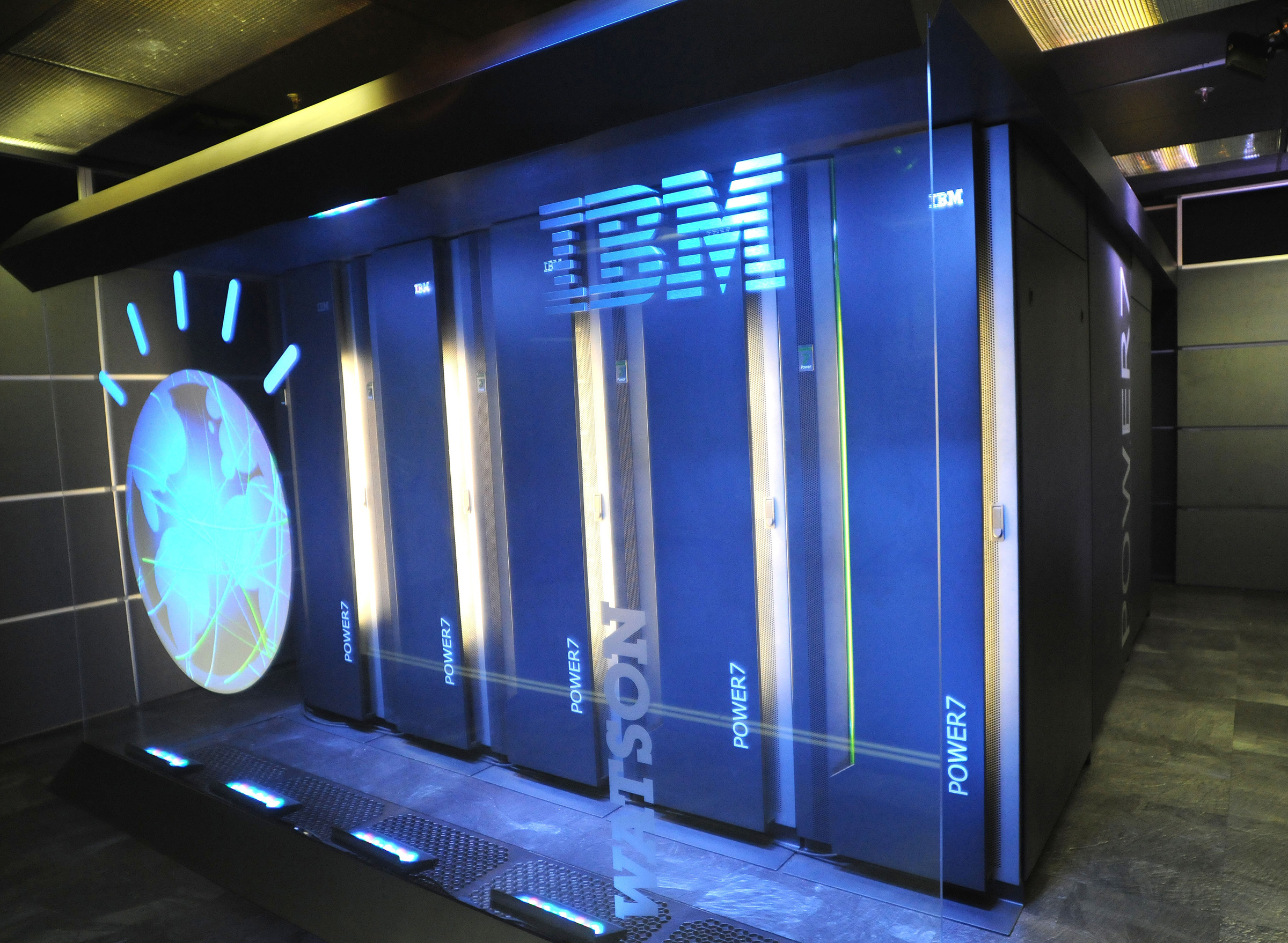
The current "smartest" computer we have.
http://www.kurzweilai.net/images/IBM-Watson.jpg |
The information above was published in 2002, being 12 years later we without a doubt have much more sophisticated and impressive computers. IBM's Watson is best known for his bout on
Jeopardy! in 2008, winning the overall competition.
Computer systems like these are just the beginning of what could happen with computers in the future. There's definitely a sharp learning curve but once we make that jump as a society, the ball starts rolling rather quickly. But is it possible that building computers to go beyond simply answering facts is morally wrong? How can we expect a computer to be able to make a moral decision for us?
 |
A military drone
http://dronewarsuk.files.wordpress.com/2010/06/predator-firing-missile4.jpg |
Many decisions in areas such as the military are as much dictated by a moral obligation as a strategic one. There are many laws governing warfare that can't be answered strictly with numbers. As mentioned by Sean O'Heigeartaigh, an author of the University of Oxford's Philosophy faculty's blog, mentions a few places we could draw the line on how robots operate autonomously in the military. The first suggestion is that humans operate "on the loop" meaning a human would verify every decision a robot creates. While this seems like the most obvious choice, it also defeats the purpose of having a machine make the decision in the first place. Both the human and the machine would have make a decision, and the two would then have to be compared in order to authorize an action. The second choice would be to have a human "in the loop", meaning a human would be available to answer moral based questions which the machine cannot be trusted to answer for itself. This option is a bit more reasonable when it comes to the efficiency of an autonomous robot, but it takes away the idea of self control. The robot is no longer making the final decision, but is just doing all the calculations for humans. The third suggestion is allowing the machine total, independent control of its actions.
 |
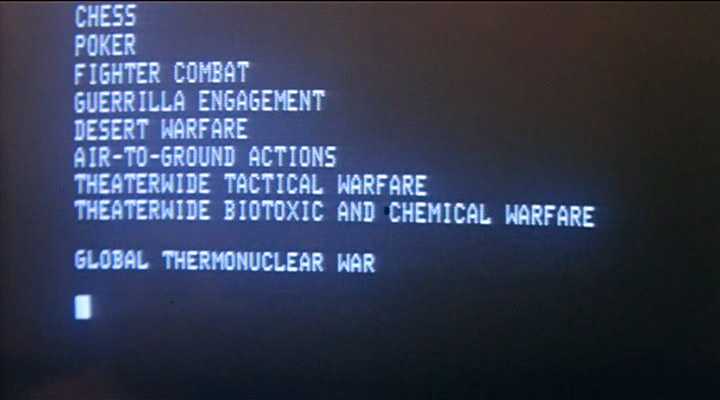
A still from the movie War Games, dealing with the problems of
artificial intelligence in the military
http://pc-museum.com/046-imsai8080/wargames-05.jpg |
The ethics of machine learning are easy when it comes to artificial intelligence that decides when to trade a stock, washes our clothes, or even builds something for us. These applications don't involve the cost of human lives with every decision made. The only time people would allow a machine to make military decisions would be when it could decide for itself what is moral, but even then it would be based on objective truth. At what point does objective truth submit its validity to the human conscience? This is a debate that will go on for what seems like forever, with no right or wrong answer in sight. By the time machines are able to calculate for themselves what is morally correct even with subjective truth, such as the historical evidence of ancient landmarks, we'll have a new debate about whether we should be capable of building a computer which mimics human emotion so closely. The mimicking of human emotion is a taboo I think we should steer clear of, at least for now. What right do we have as humans to give something else the burden of conscience we all bear?
http://news.bbc.co.uk/2/hi/science/nature/1809769.stm
http://blog.practicalethics.ox.ac.uk/2013/08/would-you-hand-over-a-moral-decision-to-a-machine-why-not-moral-outsourcing-and-artificial-intelligence/
Mitch Joa


The topic of AI and its development is indeed fascinating, and I am curious to know why you think mimicking human emotions is a taboo. There seems to be some extremely rudimentary examples of this already in so called "chat bots" and maybe a lesser degree in virtual environments such as games. However, I do agree that the wisest choice at the moment is to perform extensive research before we try to make machines any more human; most importantly, in my opinion, is the so-called "singularity" event where AI are able to improve themselves to the point where they exponentially grow and (in popular culture) proceed to destroy/enslave humanity.
ReplyDeleteI find it interesting that most of the time our main fear of artificial intelligence stems from works of fiction. But if you look at 'big dog' a robot that uses pre-set coding to make response decisions if it's knocked over or on ice and adjusts himself accordingly. One thing about this is that how long until we have a war of robots. Is there a moral issue in sending, essentially a tank, across the world without people in it. Would it be moral? Or would the people behind it be responsible to say it isn't to kill anyone, but instead deliver goods to those unreachable? The people using this technology would be more immoral than the AI. While we shouldn't be afraid of these technologies, I would be weary of them. They are a development like any other, many might say that phone was immoral back when, and many still look down upon the use of electricity. Just food for thought, it could benefit more than it could harm.
ReplyDeleteThe thing with artificial intelligence is that there are four ways to approach it. Systems that think like humans. Systems that act like humans. Systems that think rationally. Systems that act rationally. These different approaches call for very different kinds of artificial intelligence as you may already have thought of. The reason why is because being human and being rational are two very distinct things. Humans do not always act rational and sometimes we make mistakes. Secondly, acting and thinking are very different as well. Acting is all pre-programmed and every action taken has already been thought of and humanly reasoned. Thinking is not all pre-programmed. In that case, options are given and choices are made on how much weight is given to each option. Options with more weight are more likely to be chosen.
ReplyDeleteThe thing with artificial intelligence is many people are ignorant of what it is and what it can be. Many people only know of 1 or 2 approaches to it and those two give them a very biased opinion on artificial intelligence when in fact it is something very different.