One scientific topic that really comes to my mind as being
controversial is that of cloning. Should we clone? What should/shouldn't we
clone? How far will we go? Cloning is defined as (from the National Human
Genome Research Institute) a number of different processes that can be used to
produce genetically identical copies of a biological entity. The copied
material, which has the same genetic makeup as the original, is referred to as
a clone.
It has been shown that cloning animals can have numerous
benefits such as reintroducing endangered species, producing enhanced animals
(leaner meat, more milk production, etc…), and we can engineer animals to
produce proteins for medical purposes. The draw backs however are that is it
expensive and not very efficient as well as many clones develop some adverse
health effects. Plus, by reintroducing endangered species, many people believe
that you are no adding enough variety into the gene pool for that species so it
may not survive anyway.
So what all does this have to do with humans? Human cloning
is very controversial. Many people believe that this will disrupt the social
norms and values of our modern society. I believe that cloning has some merit
in society and we should further investigate its benefits and risks. One benefit
that comes to my mind is helping couples who couldn't normally have a baby be
given a chance to have a baby of their own. In addition to cloning you have
stem cells which can be ‘programmed’ to be any kind of cell. This can help cure
things such as damaged nerves or diabetes.
With this being said, I do believe that there should be some
sort of limitations if we do proceed. For example you can’t just clone another
human for spare parts. That is morally and ethically wrong. In addition, people
shouldn't be allowed to clone human armies of themselves (we have enough people
on the earth already).
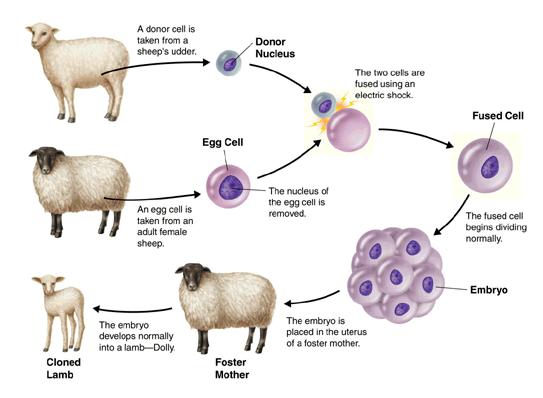
[Below is the process of cloning]


For the most part I agree with what you are saying. I think that cloning would not bring with it to many negatives that could not be easily regulated. One negative that was not addressed though is the question of whether people have a right not to have a clone of themselves made. Do we have a right to or own our set of DNA and if so can be prevent other people from using it. For example, if someone happened to acquire your DNA and could use that to clone you, you might want to be able to have some say as to whether or not that happens. This could lead to weird cases where someone wants to use a slightly modified form of our DNA and then its not clear whether or not we own that set. It just might be hard to regulate.
ReplyDeleteThis is definitely an interesting topic. I think from a social standpoint it has a lot of the same dilemmas as abortion. Primarily in the idea of "playing God" since essentially there is this inherent idea of man creating life. I personally feel that there are a ton of benefits that cloning could bring such as the restoration of extinct or endangered animals; however, I highly doubt that it will never be a controversial subject. So long as there are highly religious people then there will be a huge vocal population against any form of cloning. As the technology improves and the idea of the benefits expand across public it should be very interesting to see how it plays out politically.
ReplyDeleteCloning is something that is being researched upon every day, and is making a significant amount of progress in the field of science. I do believe that there could huge benefits to cloning, but you are right when there should be set limitations. These limitations will most likely come from people's beliefs and moral values, which will most likely create controversy. Below is an article that explains how researchers have been able to clone embryonic stem cells, one step below human cloning. If just cloning embryonic stem cells brings up ethical issues, I cant imagine how the public would react when human cloning becomes more popular.
ReplyDeletehttp://www.nytimes.com/2013/05/16/science/scientists-use-cloning-to-create-embryonic-stem-cells.html?ref=cloning&_r=0
This comment has been removed by the author.
ReplyDeleteI agree with many of the points already said from previous commenters. I think the most important issue at hand with cloning is the role of "playing God," like Andrew mentioned. At cloning's core is phrase because it is essentially a religious issue. Do we throw away the natural order of the world and introduce things that were never truly meant to be? And are we allowed to take the role of God and put the creation of life into our own hands? Then there's science that clashes with these ideas--do the scientific breakthroughs that could arise from cloning outweigh throwing off the order of things? In all honesty, I'm still conflicted with the issue and don't have too strong of an opinion on it. But I think if the process of cloning isn't severely abused, the scientific discoveries would be worth it.
ReplyDelete