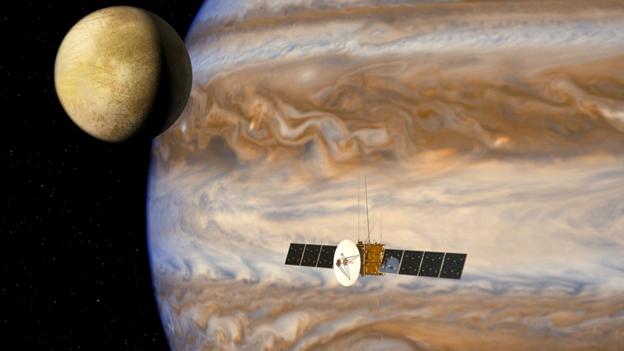
 Looking at Jupiter's Moons, Scientists have decided that both Europa and Ganymede have the ability to maintain life, or will in their future. There are observations of similar explosions and materials on Europa that is like how Earth was millions of years ago. Because these two need an "energy source, liquid water, and carbon, nitrogen, oxygen, phosphorous and sulphur" in order to maintain life and because of this these two have the potential in time to do what earth does.
Europa is favored by scientists because of the possible hydrothermo vents due to the rocky floor of the ocean. The ability to maintain life that's larger than mars' supposed microbes is due to the energy resources. While we do not know enough about human's creation on Earth, there isn't a lot of prediction if or when human life would form on Europa, but the ice that's on Europa's surface, the potential elements has the potential to create complex forms.
Unfortunately, the satellite "Juice" that they have sent to Jupiter will take sixteen years to get there, and nineteen years until it orbits Ganymede. So, the ability to truly understand what will go on on these moons will be years and years passed our time. But this sort of similarity to Earth will not only give us more of a model of how our own planet formed, but also the extent of other life form opportunities there are in space and what we have yet to find.
http://www.bbc.com/future/story/20130524-our-best-hope-to-find-alien-life

Mariisa, I like your post specifically because of a comment you brought up regarding human life forming on Europa. I completely agree that life could occur on certain moons of Jupiter because the chemical building blocks are present and there are energy sources, for example, the hydrothermal vents you discussed. Where I disagree is this idea of human life occurring in the distant future. On Earth we can trace the evolution of early life to the human species, which occurs as a result of natural selection. Unless the future conditions on Europa come to mirror those we have experienced on Earth exactly, then I think evolution would still occur, however I would expect the species to be vastly unique from the ones that developed on Earth. While I think advanced life could certainly be possible again, I doubt a species living under different environmental conditions would resemble the human species as we know it on Earth.
ReplyDeleteThis is definitely an interesting topic and a great post. Like you mentioned above, We learned in Astrobiology that both Mars and Jupiter's moons have great potential for life. Largely because mars has water caps on the north and south ends and then one of jupiter's moons titan has lakes of ethane and methane which could possibly play host to early life. Another interesting fact about Jupiter's Moons is that Io is actually extremely hot despite being so far from the sun do to its tidal friction interactions with Jupiter. Given the unique habitats of these potential life sources, it would seem that some sort of extremophile would be most likely to survive in these conditions. It will be fun to find out.
ReplyDeleteI really enjoyed reading about Jupiter's moons! It is definitely interesting to think about another place capable of having living species other than our Earth, but with such a different type of environment I doubt it will be similar to ours. Although it is going to take a very long time to discover the details about the moons, it is weird to consider a whole different world possibly forming so far away from us. The thought of a future life in such a different place is very thought provoking. I am curious to find out more about this topic!
ReplyDeleteThis is a very interesting post. It's crazy to think that there might other life right in our own solar system. I'd agree with you that if there is life on one of these moons, that this changes the odds of finding life elsewhere. However, I am not sure that either of these moons could serve as a model for the development of Earth. While they may be similar in many respects, they seem to be dis analogous enough that the development of one won't really serve as a guide for the development of another.
ReplyDeleteWhile I commend your willingness to discuss very foreign concepts, I'd like to critique some of the claims you made in your post.
ReplyDeleteWe certainly have a very good understanding of human creation and the evolutionary process. The theory of evolution is a fact, it is Darwinian natural selection that is the theoretical portion, yet even there it has yet to be proven false. The notion human life would form on Europa is quite outlandish. It would take millions upon millions of years for this to happen. It is for this reason the microbes on mars are such a large discovery. Even the most simple organisms are a rare and extreme find.
Despite this, you make a very valid point about energy. Mars' geothermal activity is long dead, making the possibility of complex organisms extremely unlikely. Europa and other moons orbiting Jupiter are surely the next great step in searching for life in our solar system.
On a side note, astronomers have made a recent discovery that has made them rethink whether or not another earth-like planet is in our solar system undiscovered. It may be worth your time to look into this if you are interested.
I have heard about this recently and my first reaction is will human life, or any form of intelligent life be around to inhabit it. Life ending on earth and moving elsewhere is a weird and common sci-fi theme in many movies but hard to think about. In a few million years when life on jupiter's moons is inhabitable life on earth definitely will not be livable so I guess it makes sense. I wonder what kind of evolution will take place there and how long it will take for intelligent life to form on the moons and if they will ever know of our civilization that took place over the course of a millisecond relative to the universe's life span thus far.
ReplyDeleteThe theory about the possibility for human life formation on one of Jupiter's moons is interesting. It's also interesting that the possibility for life is on the moons not the actual planet. The discovery of this information about the two moons is also interesting because it could provide a glimpse into how Earth looked millions of years ago and provide us with more information about the evolution of life on earth.
ReplyDelete